
Dear Reading Votes Reader:
🎉First, let’s welcome-in the 2026 year — hope you all had a memorable 2025 and are ready to engage in this year’s efforts to bring Common Sense to Reading.
Candidates Needed:
The balance is shifting at Town Meeting and in several committees and boards toward a more progressive electorate. We need Common Sense candidates to step up to keep focus on local matters, and to tackle problems that impact all residents of Reading. Don’t do this because we ask, do it because these issues impact you and your family and this is your opportunity to make a positive impact. Town meeting is a great way to jump in! Please, consider running for any one of the elected positions this spring.
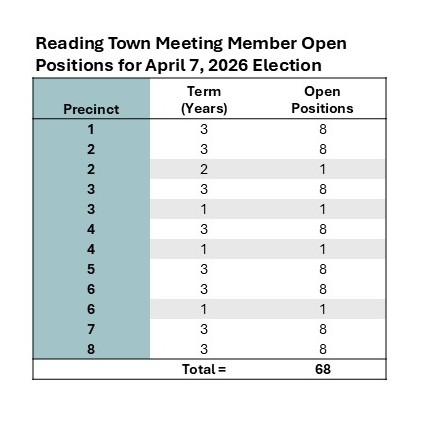
Open Positions for Apr 2026 Election:
- Town Meeting candidates are needed in all all precincts (see table below)!!!
- 8, 3-year term positions per precinct
- 1, 2-year term position in Precinct 2
- 1, 1-year term position in each of Precincts 3, 4, and 6
- 2 Select Board (Carlo Bacci, Salvatore Bramante, Anthony D’Arezza and Karen Herrick)
- 2 School Committee (Geoffrey Coram, Erin Gaffen, and Lori Hayes)
- 2 Board of Library Trustees (Christian Cappy Popp and Monette Verrier)
- 1 RMLD Board of Commissioners (Robert Coulter)
- 1 Town Moderator (Alan Foulds)
Register to Vote: In addition to ensuring YOU are registered to vote, be sure to encourage those who have recently become eligible to register by March 28, 2026 at 5:00 PM.
It’s Easy to Pick Up Nomination Papers At Town Hall: Please, consider running and speaking with like-minded neighbors, friends, and relatives about joining you. If you are new to the idea of volunteering and reside in Precincts 2, 3, 4 or 6, consider pulling papers for one of the 1- or 2-year term positions that are available this year (see above).
- 🗓️Feb 17, 2026 = Last day to pick up nomination papers
- 🗓️Feb 17, 2026 = Nomination papers due by 5:00 PM
- 🗓️Apr 7, 2026 = Town Election Day
KEY UPDATES FROM THE READING TOWN MEETING
Highlights From The Last Town Meeting:
At the end of last year, Reading held its fall 2025 Town Meeting on Nov 10, 13, 17 and 20. During these four nights a few important decisions were made that will have a significant impact on our Town Government.
Charter Review Changes:
Every ten years, the state requires a review of the Town Charter. For nearly two years, a dedicated review committee has worked to present recommended updates to this foundational document, which governs the structure, rules, and regulations of our Town Government. The Charter outlines the creation and operation of all town offices, boards, committees, and commissions, and establishes the rules for hiring and firing the Town Manager and other essential staff positions. Originally adopted in 1976, the Charter has been periodically amended to reflect new policies, state mandates, and best practices.
A complete list of the proposed Charter changes, shown in redline form, is available here.📝
While many of the revisions are editorial, such as updating language to be gender-neutral or specifying roles instead of using “he/she.” Several more substantive and sometimes contentious changes were also introduced.
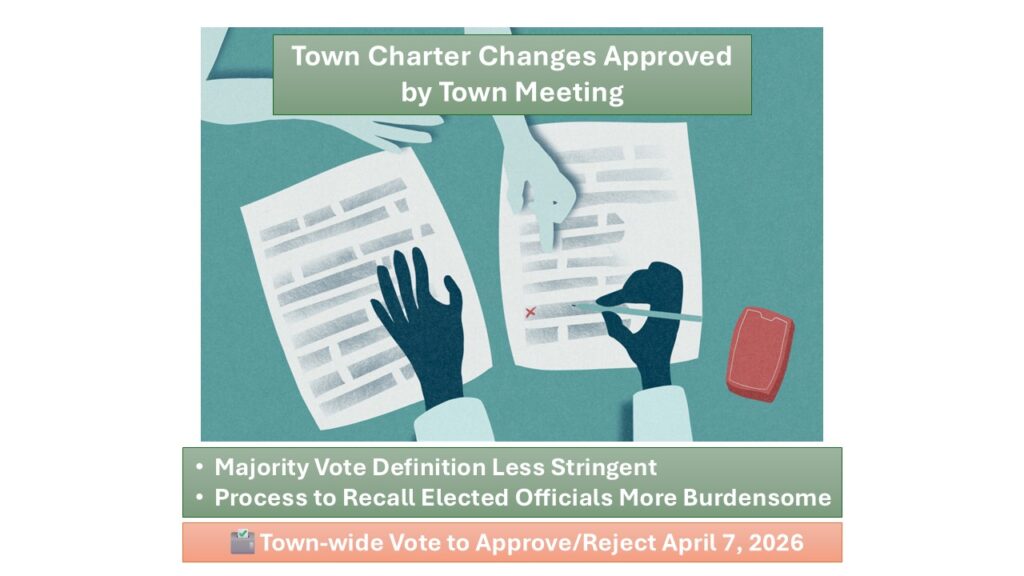
Redefining “Majority Vote”:
The first major issue concerns the definition of a “majority vote.” Previously, the majority required for a board, committee, or commission (other than Town Meeting) was based on the total number of authorized members. For example, with five voting members on the Select Board, a majority meant three votes. The newly approved change redefines the majority as the majority of those present at a meeting.
Though this may appear minor, it carries a significant implication: decisions on important issues could now be made by a minority of the full board if attendance is low. Melissa Murphy spoke against this change, citing a recent situation where only three Select Board members were present to vote on the split tax rate. Under the previous rule, all three needed to agree, ensuring a consensus. Under the new rule, only two votes would suffice. While some noted the challenges in achieving a quorum, which the new rule aims to address, others argued that this should not justify lowering the threshold for decision-making. A suggestion was made to apply the relaxed majority definition only to appointed boards, retaining the stricter requirement for elected bodies to better reflect the will of the voters, however this deemed outside the scope of the changes and therefore not allowed.
Increased Requirements for Recall of Elected Officials:
The updated Charter now makes recalling elected officials more difficult. Town Meeting has approved doubling the number of signatures required for a recall from 10% to 20% of registered voters—an increase from approximately 2,100 to 4,200 signatures. Since the Charter’s adoption, there has only been one recall instance. Regardless of opinions on that recall, Reading Votes considers the new threshold excessively burdensome, potentially to the point of ineffectiveness. While recalls should remain a last resort, they should not be out of reach. It is also worth noting that many local elections struggle to attract 20% voter turnout, although some argued that collecting signatures for a recall is not the same as motivating voters to cast ballots, which is true.
Your Role: Make Your Voice Heard
What can you do? Talk with your neighbors and make sure to “speak” through your vote on Election Day, April 7, 2026. The updated Charter and these changes will now appear on the ballot, and require approval by the majority of voters to become effective! 🗳️🗣️🎤📢
Until next time . . .
Comments 1
Pingback: CANDIDATE ENDORSEMENTS ARE HERE! | Reading Votes